
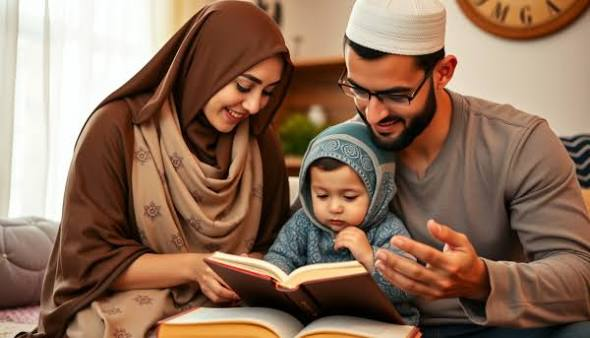
One of the most important issues for Muslim parents raising children in the United States is how to teach children about Islam when mosques, Islamic schools, and Arabic-speaking communities are not necessarily close at hand. Children are exposed to a different language, a different day-to-day life, and a different culture than their parents. In view of this, many families have begun to re-evaluate their methods of introducing young learners to the Quran, with many opting to adopt a more regular practice that is more guided and integrated into their daily family life.
The Challenge of Teaching Young Learners
Children learn things differently from adults. They have a shorter attention span, a greater curiosity, and need to learn in relation to how it is taught. To teach a child to recognise Arabic letters, to understand the basic rules of Tajweed, and to eventually recite verses correctly, patience is required, and a method must be utilized that is appropriate to the way young minds learn, through repetition, encouragement, and small attainable steps, not long arduous sessions.
Many families will struggle at this point. A local Islamic centre may only provide classes in groups, which can be on the weekends, and have large class sizes, making it difficult to get one-on-one attention for a young child. Some children are unable to keep up with others in the group; others become disinterested because the environment is not interesting enough to capture a child’s attention for a long time.
Making Learning Accessible for Every Family
To meet these challenges, many parents have embraced more flexible and individualized approaches. Online Quran classes for kids have gained popularity as an option, as it enables a child to get personal one-to-one attention from a qualified tutor, without the need for the family to travel anywhere or adhere to a set schedule and routine. A session can be scheduled around a child’s homework or other extra-curricular activity or even their nap time with the younger children, so it is much easier to maintain consistency with other options.
Families with several children of differing ages and learning levels also benefit from this kind of flexibility as each child can be working through learning material that is appropriate to their developmental stage, and not placed in a class with others who are either ahead or behind. Parents are welcome to join in with sessions, particularly for younger children, to help them to participate in their child’s religious education and strengthen learning in the home between sessions.
What is a Good Learning Experience for children?
There are various methods of teaching, but they don’t always work for younger children, and a lot of it depends on certain things. First, teachers who have experience teaching children have a preference for short snippets and repetition games, as well as visual aids, rather than long, uninterrupted lessons. Secondly, positive reinforcement is a key factor — children are far more likely to be motivated by encouragement and celebration of small steps than by correction.
Another essential is consistency. Children learn best when they have many short sessions spread out over several days or weeks rather than when they have fewer but longer sessions, as they tend to remember more what they learn if it’s repeated at regular intervals. Last, a quiet area free from distractions, at home or in a specific study space, enables children to concentrate and makes them understand that it is an important part of their schedule and not something they do at the last minute.
Parents’ role in the learning process
Rather than that, the role of the teacher is the most prominent in teaching, but the role of the parent is still very important in the child’s learning the Quran. By reviewing the material from a lesson, having children read back what they have memorized, or establishing a daily practice time, reinforcement of the lesson content occurs, and children are taught that this is important to the whole family and not just to the teacher.
Parents also play a role in helping to set expectations. Children progress at different rates in reading, memorising and other areas, and comparisons with other children’s speed can put unnecessary pressure on children. Children’s confidence is strengthened, and their motivation to practice is maintained by celebrating their small successes, whether it be correctly saying an unfamiliar letter, or finishing a short surah.
Conclusion
It doesn’t need to be a perfect environment or a close Islamic center to help children connect with the Quran; it only needs to be a consistent, patient, and child-friendly approach. In today’s fast-paced world, where more and more families are looking for practical solutions to accommodate religious education in their busy lives, online Quran classes for kids have become a great solution that offers children structure as well as individual attention in a flexible format in which kids successfully learn the Quran. If parents’ involvement is complemented with proper and qualified teaching, a wholesome and confident relationship with the Quran can be developed among children irrespective of their location in the country.